
Sugar Hill Records and Access
The richest records tied to Sugar Hill are county records. Gwinnett County keeps deeds, property assessments, most court cases, probate estates, tax accounts, and voter registration. Sugar Hill keeps its own council, contract, permit, business-license, code, municipal-court, and other city-created files. State offices add vital certificates, corporations, professional licenses, and corrections data. The coverage column below distinguishes a stated date from a portal whose starting point was not published.
| Record Set | Record Keeper | Web Index | Coverage | Access Route |
|---|---|---|---|---|
| Deeds, liens, and plats | Gwinnett Superior Court Clerk | GSCCCA Real Estate | Surviving records from Sept. 26, 1871 | Index and paid web images; free office viewing |
| Court cases | Relevant city or county clerk | Gwinnett Courts Portal | Starts vary by division | Free docket search; counter or paid documents |
| Property and tax | Tax Assessor and Tax Commissioner | Property Search and tax account tools | Current web roll | Free search; archived cards by request |
| Birth and death | Georgia DPH or Gwinnett Probate Court | No open recent-person index | Births become public after 100 years | Eligible requester, ID, application, and fee |
| Marriage and divorce | Probate Court and Superior Court | Estate/court portal coverage varies | DPH reports cover 1952-1996 | County certificate or court-file request |
| City records | Sugar Hill records custodian | Request channel rather than broad index | Series-specific | City open-record request |
Open status and online status are different. A public file may exist only at a counter or in storage. Sealed cases, adoption files, most juvenile material, protected voter addresses, recent vital certificates, driver data, and certain investigative or personal details remain closed or redacted. An open-record request cannot cancel those protections.
Sugar Hill Deeds in GSCCCA
The Gwinnett County Clerk of Superior Court records deeds, security deeds, liens, plats, condominium plans, partnerships, and several less common series. Its online gateway is the GSCCCA Real Estate index. A grantor is the party transferring an interest. A grantee receives it. Search a surname or entity in both roles because a person can appear on either side of a transaction.
| Search Control | Input | When Required | Useful Detail |
|---|---|---|---|
| County | Dropdown | Always | Select Gwinnett |
| Search Type | Mode or tab | Always | Name, book/page, instrument, property, or plat modes |
| Last or Company Name | Text | Name mode | Try surname, entity, trust, and spelling variants |
| First Name | Text | Optional | Reduce to an initial if indexing differs |
| Party Type | Selector | Optional | Grantor, grantee, or both |
| Instrument and Dates | Dropdown and date pair | Optional | Narrow by document kind and recording window |
| Book/Page or Instrument No. | Text | Selected mode | Use a known clerk citation |
Results may show party role, document type, recording date, deed book and page, instrument number, and an image link. The index is a finding aid, not the certified instrument. Online image access may require an account or fee. Book and page are worth saving even when the image is unavailable.
Note: All Georgia real-estate documents have required electronic filing since January 1, 2025, but that rule does not end public counter inspection.
Sugar Hill's 1871 Record Break
Gwinnett's surviving real-property series begins September 26, 1871. Earlier county courthouse records were lost by fire. That date is not just a website cutoff. It marks a loss in the original deed chain. A search that stops before the date has reached a historical break, not proof that an ancestor owned no land.
For an earlier Sugar Hill family, shift to tax digests, census schedules, probate minutes, court minutes, legislative material, church and cemetery records, newspapers, and family papers. Georgia Archives and cataloged FamilySearch microfilm may help identify surviving substitute sources. Later deeds can also refer back to heirs, neighboring tracts, or an older legal description.
Free Gwinnett Record Viewing
A paid web image is not the only deed channel. The clerk permits free searching and viewing in the Deeds and Land Records room at 75 Langley Drive in Lawrenceville. The office reports weekday hours of 8:00 a.m. to 5:00 p.m., with its recording counter closing at 4:30 p.m. The main clerk number is 770-822-8100. This offline option matters when GSCCCA access is gated or an old index entry needs staff help.
Counter advantage. Bring the county, both party names, rough recording date, document type, and any book/page or instrument number. Free viewing does not make printed or certified copies free.
The clerk's current guidance lists printed deed copies at $2.50 for the first page and $1 for each added page, while a large plat is $10. Ask for a current quote before ordering. Electronic certification can deliver a secured PDF, while a plain download or screenshot lacks the clerk's certification.
Sugar Hill Court Record Custody
No single court covers every Sugar Hill matter. Municipal Court handles qualifying city ordinance and traffic cases. Gwinnett Superior Court handles felonies, divorce, title, and equity. State Court handles misdemeanors and general civil cases in its jurisdiction. Magistrate Court hears small claims and other assigned matters, Probate Court keeps estates and licenses, and Recorder's Court handles many county ordinance and traffic cases. Federal cases belong to the Northern District of Georgia.
The Gwinnett Courts Portal uses Smart Search for a party name or case number across Superior, State, Magistrate, and Probate estate cases. A result can show the case number, style, court, type, filing date, status, party roles, lawyers, hearings, and disposition entries. Start dates vary, and online calendars are not official records. For the full file, use the relevant clerk's terminal or request channel. Documents may route to paid re:SearchGA, while sealed, adoption, and juvenile material stays unavailable.
State Court's published schedule gives a local reference of $2.50 for the first certified page and $1 for each later or plain page. Charges can differ by division and product. Ask before ordering a large file.
Sugar Hill Property Record Geography
The Gwinnett Tax Assessor Property Search accepts owner name, property address, or parcel ID. A parcel card may list the owner, mailing address, situs address, legal description, values, exemptions, sale history, building traits, and a map link. Situs means the land's physical location. The mailing address is where tax notices go, so it may point elsewhere.
A Sugar Hill mailing label does not prove that land is incorporated in the city. County deed and tax custody stays the same across annexation, but the keeper of permits, code files, municipal incidents, and local court material can change. Use the Gwinnett GIS Data Browser to check parcel shape and municipal limits, then direct the request to the city or county office that held jurisdiction on the event date.
Assessment data is not a title opinion and can lag a recent transfer. A deed proves conveyance, not occupancy. Those limits make parcel ID, legal description, and recording date more reliable than a city label alone.
Sugar Hill Vital Record Limits
Recent birth and death certificates are restricted under O.C.G.A. §§ 31-10-25 and 31-10-26. Gwinnett Probate Court provides local birth and death service, while Georgia DPH maintains statewide records. A birth certificate becomes public after 100 years. Until then, an eligible requester must use the current application, show accepted identification and, when required, prove relationship or authority.
The current core charge is $25 for the first certified birth or death copy and $5 for another copy of the same record in one order. Gwinnett Probate Court's 2026 fee book lists a marriage certificate at $10. Marriage certificates come from the county that issued the license. Divorce decrees come from the Superior Court file, while DPH's 1952-1996 divorce reports are a different product.
The official Georgia vital-record ordering page lays out online, mail, and walk-in channels. Online vendors add charges. Mail requests need the current form, ID copy, and prescribed payment. Published 2026 estimates are two to four weeks online, up to five business days expedited, eight to ten weeks by mail, and same-day state or county walk-in service.
The state ordering screen illustrates that this is an application process, not an open recent-person index.
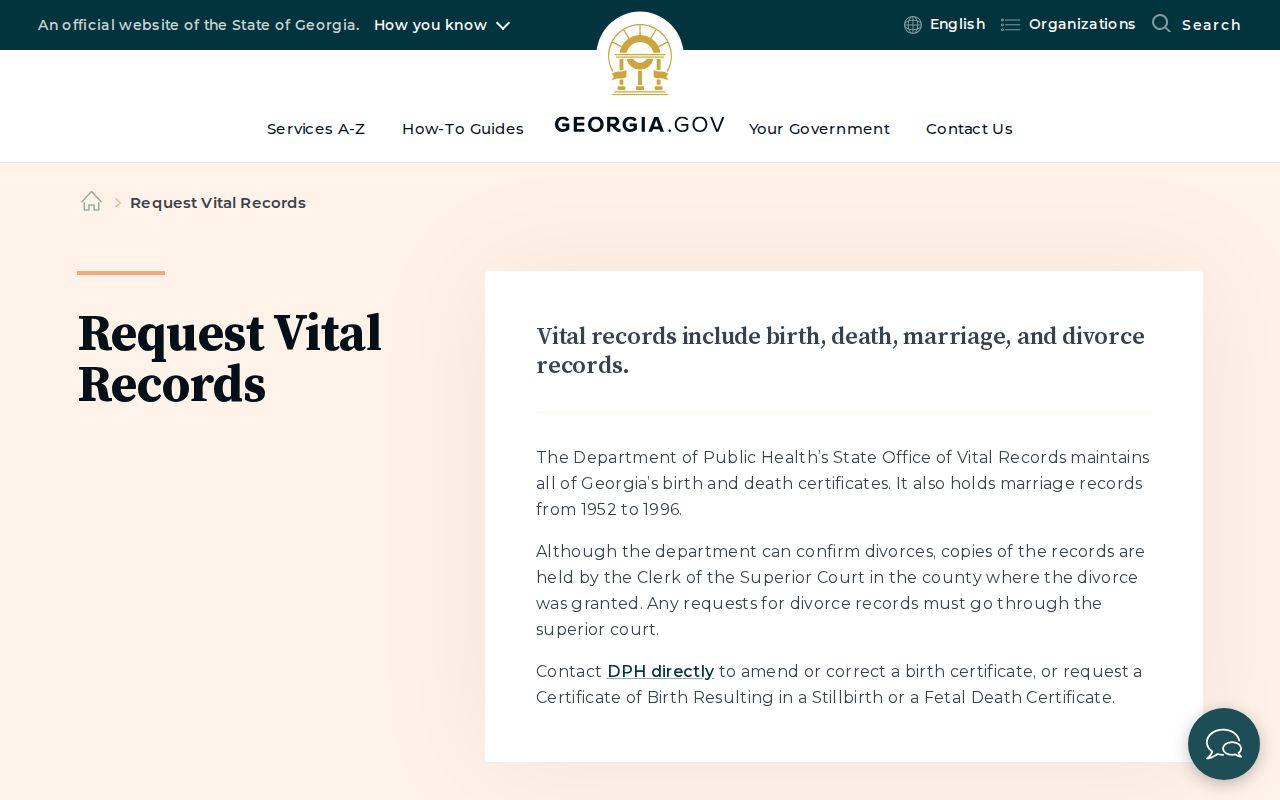
Its choices route a qualified requester to the right certificate and delivery method; they do not expose protected certificate data for browsing.
Sugar Hill Public Records Offices
Choose the office by who created or maintains the record. County counters are in Lawrenceville because Sugar Hill is not the county seat. Calling first can confirm current hours, eligibility, storage location, and copy product.
Gwinnett Deeds and Land Records
75 Langley Drive
Lawrenceville, GA 30046
770-822-8100
Gwinnett Probate Court
75 Langley Drive
Lawrenceville, GA 30046
770-822-8250
Sugar Hill Records Custodian
City-created records, including local permits, minutes, contracts, and license material
The city channel is best for a record Sugar Hill created. County deeds, tax rolls, and most court files should not be sent there. For older or off-site county material, ask the responsible clerk about retrieval time, public terminals, mail copies, or electronic delivery before making the trip.
Sugar Hill Record Terms
Access choices are easier to compare when each product has a clear meaning. These terms recur at city, county, and state offices.
- Index
- A finding list with names, dates, record type, and a citation. It may not include the document image.
- Certified copy
- A copy authenticated by the custodian for uses that require official proof.
- Custodian
- The agency or official responsible for keeping and responding for a record.
- Exemption
- A law that permits or requires specific content to be withheld from access.
- Redaction
- The removal of protected details while the nonexempt part is released.
An index hit should lead to the underlying file when the distinction matters. Conversely, asking for certification when plain electronic inspection is enough can add cost.
Protected Sugar Hill Record Categories
Georgia's access policy is broad, but exemptions and separate statutes remain binding. O.C.G.A. § 50-18-72 covers several protected categories. Court sealing rules close sealed filings. Title 31 controls vital certificates, Title 21 protects defined voter fields and VoteSafe addresses, and the federal Driver's Privacy Protection Act restricts motor-vehicle personal data.
Agencies may also redact Social Security numbers, protected addresses, security data, victim details, and qualifying active-investigation content. Recorded military discharges receive special limits. If part of a record is exempt, ask for the segregable public portion. A custodian should identify the legal basis for withheld material rather than treating every file in the same folder as closed.
Lawful personal use. Public access never permits stalking, threats, or repeated harassing contact. Georgia stalking and harassing-communications laws include O.C.G.A. §§ 16-5-90 and 16-11-39.1.
Request Sugar Hill Public Records
The Georgia Open Records Act, O.C.G.A. §§ 50-18-70 through 50-18-77, allows any person to request agency records. When practical, the agency must produce records or give a legally sufficient response within three business days. If production needs more time, the response should describe the responsive material, cite exemptions, give a timetable, and estimate cost.
- Find the custodian. Identify whether Sugar Hill, Gwinnett County, a court clerk, or a Georgia agency created the file.
- Check the index. Save exact names, dates, parcel, case, report, book/page, license, or instrument numbers before writing.
- Describe an existing record. Give the record series, subject, date span, department, and desired electronic inspection or copy format.
- Set a cost limit. Ask for an estimate and permission to narrow the scope before charges pass a stated ceiling.
- Keep the response. If material is withheld, ask for the cited exemption and release of all segregable nonexempt parts.
- Escalate carefully. Contact the agency open-records officer, then consult Georgia Attorney General open-government guidance or judicial remedies if needed.
Agencies may charge actual media cost and reasonable search, retrieval, and redaction expense, generally based on the lowest-paid qualified worker. The first quarter-hour of staff time is free. Prepayment may be required when an estimate crosses the statutory threshold. A narrow electronic request often reduces both delay and cost, but it cannot force an agency to create a report that does not exist.